


Peer-to-peer sharing worked. It is what nobody saw coming; the exhibitors were responsible for this, and every registration could be directly traced back to its source.
Once HD Expo allowed Forge to include its entire community in its promotion efforts, it could no longer ignore the results. Peer-to-peer sharing resulted in 2,671 registrations, which was about one in four of an event attended by more than 10,000 people. The people responsible for making a difference were the exhibitors.
The Reach You're Paying for Is Already in the Room
It is something that all brand marketers know well, the limits of paid marketing. Consumers become more cynical about ads each year; the people you really want to reach are the hardest to pay for access to, and all the lines get more attention than ever. There is an alternative solution that has always been right under our noses: the people who make up your audience, their networks bigger and more trusted than anything built by brands. The problem has always been one of measurement. Advocacy and referrals sounded good on paper, but measuring their impact has been difficult, so they haven't gotten the budget.
This is what HD Expo is all about.
What HD Expo Did
The Forge marketing team took a page from more marketers’ books and marketed to their own community. They gave attendees, speakers, and exhibitors a convenient way to market the event to their own communities on 17 different social media channels, from LinkedIn through email and direct messages, using pre-created content that was easy to post in one click.
The Results
What is often treated as unmeasurable goodwill became a trackable acquisition channel:
- 2,671 registrations came directly from peer-to-peer sharing, accounting for roughly 1 in 4 registrations across the 10,000-plus-person show.
- 78% of those registrants became verified attendees.
- Peer-to-peer sharing became the #2 registration source, behind only HD Expo’s own website.
- Community-driven landing pages generated 108,211 views.
- 20,435 emails were sent on behalf of the community, with a 61% open rate.
- Attendees and advocates generated 1,365 social shares.
- The top individual advocate drove 208 registrations alone.
But what made it interesting was the positioning of Peer-to-Peer among all the registration channels for HD Expo. Co-Marketing, as named by the company, was the second largest channel for registration after their own website, with conversion at 33%. It wasn’t just an estimate; 78% of those registrations via referral were confirmed attendees. Real people with badges on them!
Not Every Advocate Plays the Same Role
Those figures mask a much more fascinating tale of the different behaviors exhibited by each cohort. All three groups participated in the program, and each of them participated in their own unique way.
The attendees made the largest net reach of all groups. Over 6,000 of them participated in the campaign, and their sheer size made the campaign reach many peers of those participants who would never be exposed to paid advertising in the first place, yielding a 30.63% click-to-sign-up rate for those that shared.
The speakers, on the other hand, were the most active of all groups. Over a hundred of them participated in the campaign and achieved a staggering 66% sharing rate, as they are essentially promoting a session which they themselves will be participating in.
The exhibitors were the closers. Over 1,600 of them were mobilized and contributed to the vast majority of registrations. This was no coincidence, as filling up the exhibition space is their ROI, and they had every incentive to promote the conference.
The Campaign in Action
The same mechanic looked a little different for each kind of advocate. A few real examples from the show:
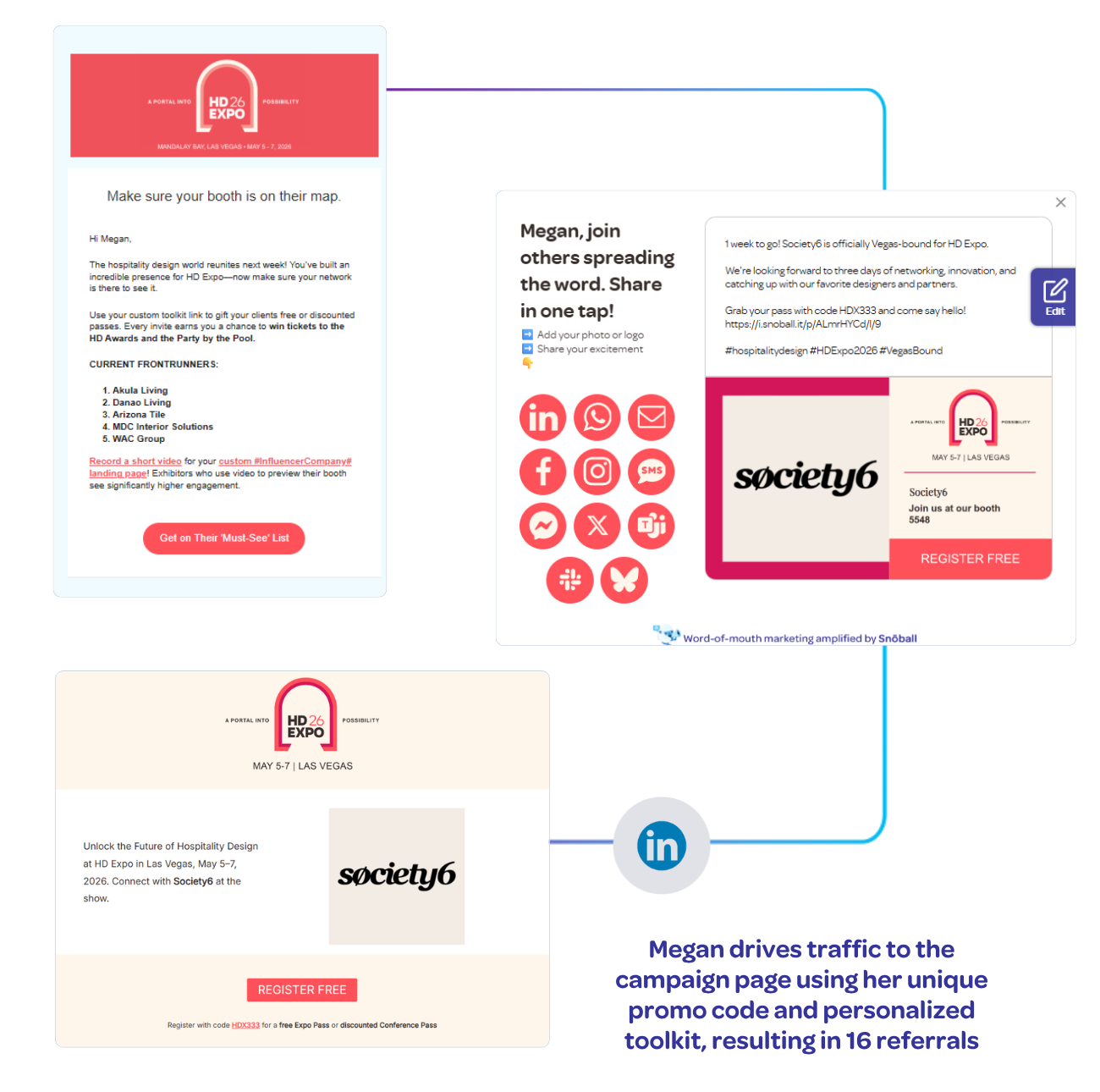
Exhibitor: Society6's team shared a personalized booth invite in a single tap. Their outreach drove 16 referrals.
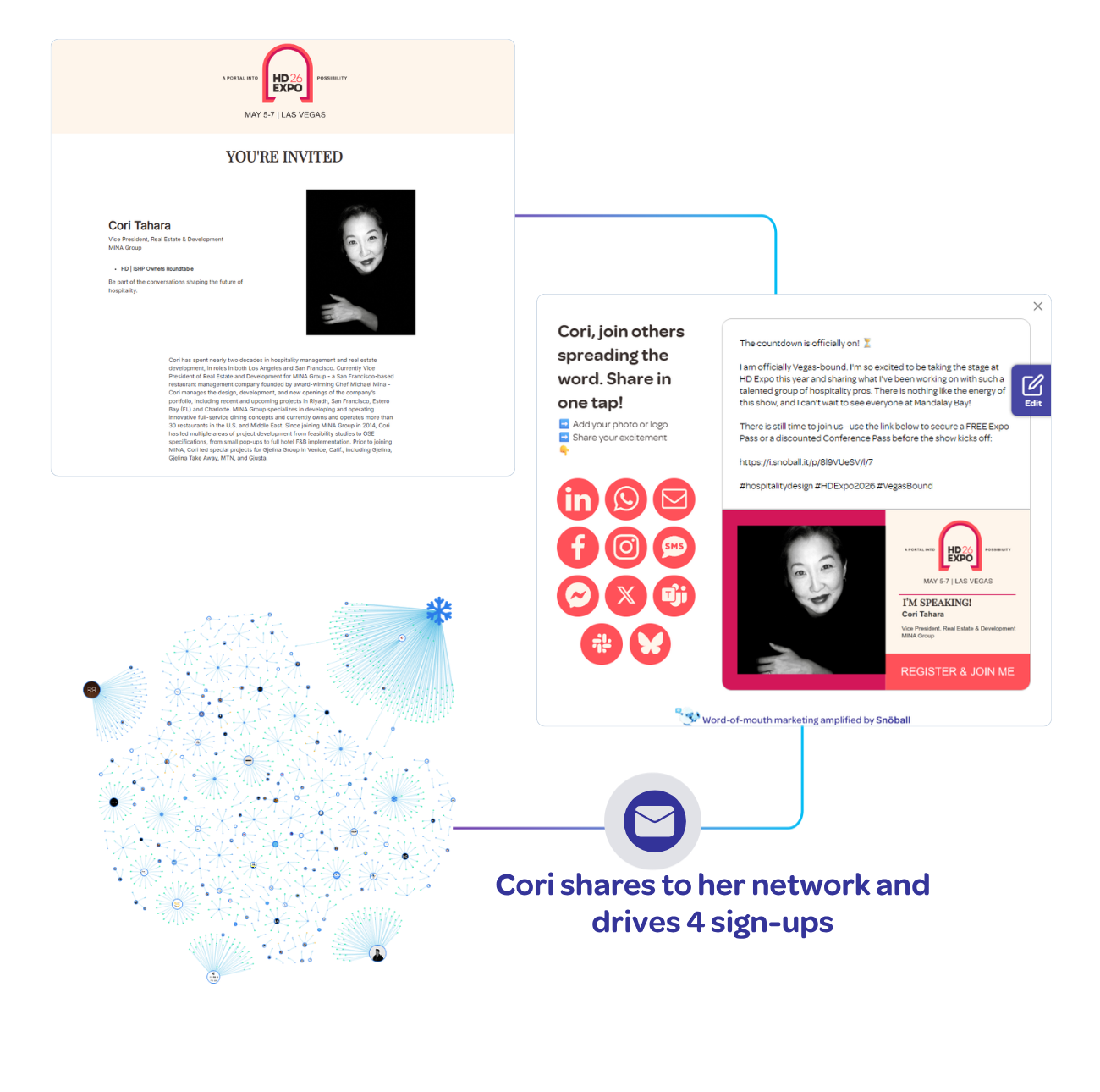 Speaker: HD Expo speaker Cori Tahara shared her session to her own network, driving 4 sign-ups.
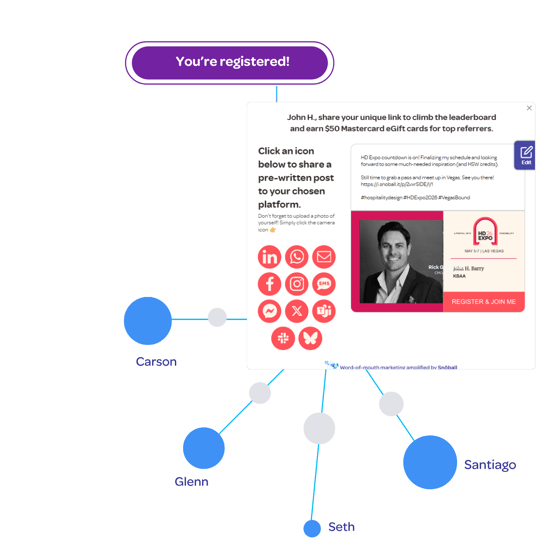
Attendee: after registering, attendees were prompted to share a pre-written post, with a leaderboard and gift-card rewards for top referrers.
Peer-to-Peer Sharing You Can Finally Measure
The thing is that referral and peer-to-peer marketing has been effective all along. It just lacked visibility. This problem was solved at HD Expo. In light of the fact that every single share was monitored starting from the very moment of its distribution until the registration was made, it became quite clear who exactly referred and what channels were the most effective: LinkedIn generated the most referrals, and email was responsible for the most exhibitor sign-ups.
“Data features that Snöball offers save me time to build smarter marketing campaigns and prove ROI.” Katie Genovese, Senior Director of Marketing, Forge
The Takeaway
This is an example of the Event Story, but the rule holds true for everything. No matter whether it is about filling the expo show floor or introducing new products or even distributing articles, the people who care about your work will distribute it farther than any single person can do on their own. Making such sharing trackable helps discover which users are amplifiers and who is your real target audience. The most efficient and trackable channel for most brands is their audience itself.

Comments